
Vertical vs Horizontal Air Receiver Tanks: Which Design Works Best for Your Factory?
 By Admin |
 October 10, 2026
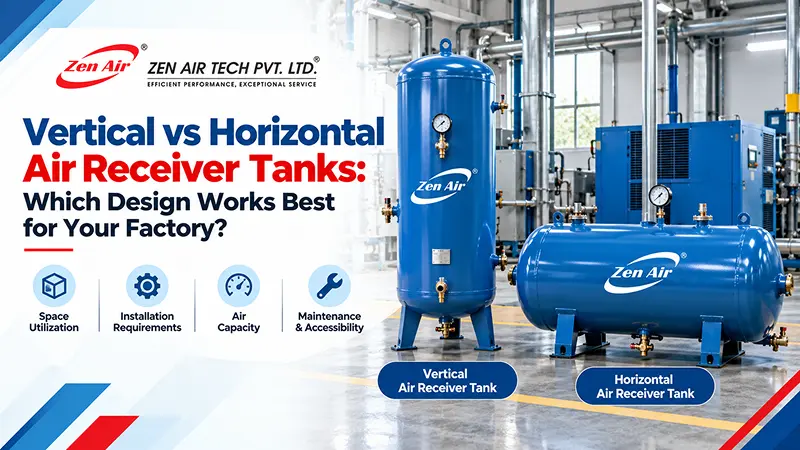
An air receiver tank is an important part of many industrial compressed air systems. It has the functions of storing compressed air, regulating pressure fluctuation and stabilizing operation of the system. When both vertical and horizontal models are available, however, it can be confusing to determine which design is the right one.
When businesses are considering a vertical air receiver tank in India, they should account for space availability, air requirement, installation requirements and maintenance requirements. Zen Air Tech provides compressed air products and accessories for industrial purposes.
What Is an Air Receiver Tank?
The air receiver tank is the storage tank that holds the compressed air produced by the compressor. It helps in fulfilling short periods of high demand for air, minimizing the number of load and unload cycles of the compressor, and gives sufficient time for the separation of moisture in the air.
Vertical vs Horizontal Air Receiver Tanks
Both designs accomplish basically the same purpose, but their shape dictates installation and accessibility.
1. Vertical Air Receiver Tanks
A vertical tank stands upright and has a low footprint for its capacity. It is useful in factories where the compressor room is limited or where clearance is needed in the production area. It can also be designed to allow easy access around the base, if it is spaced out to make this possible.
However, the available ceiling height, floor strength and safe access for inspection must be checked before installation. The tank should be secured and installed as per the design and relevant safety norms.
2. Horizontal Air Receiver Tanks
A horizontal tank runs with its length along the floor and tends to take up more floor space. It may be applicable for installations where ceiling space is restricted or where horizontal equipment is already installed. Depending on design, it may also be more straightforward to incorporate into specific packaged compressor systems.
The main consideration is whether the factory has enough room for the tank, connecting pipes, drainage and maintenance access. A horizontal design is not necessarily superior; it depends on the specific conditions.
What Should You Consider Before Choosing?
Available Installation Space
Measure the installation area before selecting a tank. Use vertical models to save floor space or horizontal models for spaces that are limited in height. Provide clearance for inspection, drainage and servicing.
Air Demand and Tank Capacity
The capacity of the tank should match the compressor output and the plant’s compressed air requirement. Equipment that operates on an intermittent basis may require enough air storage to manage short-time surges. The tank must be the proper size: too small and it will not work as intended, too large and it will cost more than it should.
Working Pressure
Verify the maximum operating pressure of the system, and choose a tank that will meet that specification. All connected components (pipes, valves and safety devices) should be appropriate for the intended application.
Moisture Removal and Maintenance
Compressed air may contain moisture which condenses inside the receiver. Good drainage is essential to prevent the accumulation of water and protect downstream equipment. An auto drain valve can help remove condensate automatically. Check drain valves, connections, outside surfaces and safety devices per the maintenance schedule.
Safety and Compliance
Air receiver tanks are pressure vessels and have to be installed, inspected and maintained in compliance with regulations. Before buying, check the necessary certification, inspection arrangements and safety provisions.
How to Find the Right Tank for Your Factory
If you are looking for a vertical air receiver tank supplier in India, please inquire about the capacity, pressure rating, material specifications, documentation and technical support. Share your compressor capacity, operating pressure, air consumption and installation measurements so the supplier can help identify a suitable model.
A vertical air receiver tank in India should not be chosen only on the shape of the tank but on the whole compressed air system. Zen Air Tech is available to help businesses evaluate the appropriate compressed air equipment and accessories that fit their needs.
Conclusion
Vertical tanks can be advantageous when floor space is limited and horizontal tanks can be beneficial for areas with limited height or an existing layout. Both can be used in industrial compressed air systems if they are selected, installed and maintained appropriately. Capacity, pressure, space, drainage and safety are all factors to consider before deciding.
Need to find the right air receiver equipment? Haven’t decided on the type of compressed air system for your factory yet? Let Zen Air Tech discuss the options with you and answer any questions about your factory’s compressed air needs.
FAQs
A vertical tank typically requires less floor space than a horizontal tank of equal capacity.
Take into account the compressor output, the air demand, the system’s pressure and operating pattern.
Yes. The pressure vessel regulations and the manufacturer’s instructions for inspection and maintenance should be followed.
Copyright © Zen Air Tech Pvt. Ltd. | Powered by : #1 Vinayak InfoSoft - SEO Company Ahmedabad.